
What Bitcoin rollups actually do
Bitcoin rollups are Layer 2 scaling solutions that bundle off-chain transactions and post them to the Bitcoin L1 for settlement. This mechanism allows the network to process more transactions and support complex use cases without sacrificing Bitcoin’s security. Unlike sidechains, which operate independently and prioritize speed over security, rollups lean heavily on Layer 1 verification to ensure integrity.
The core function of a Bitcoin rollup is aggregation. It takes many individual transactions, compresses them into a single batch, and posts that batch to the main chain. This reduces network congestion by treating a large group of transfers as one verified event. The security model remains anchored to Bitcoin’s proof-of-work consensus, ensuring that the L2 benefits from the same robustness as the base layer.
By settling on L1, Bitcoin rollups maintain the trust assumptions that define the asset. Users gain the speed and lower fees typical of Layer 2 environments while retaining the finality and security guarantees of the Bitcoin blockchain. This approach scales the network’s capacity without introducing new, independent validators that could fragment the ecosystem.
Optimistic vs ZK rollups on Bitcoin
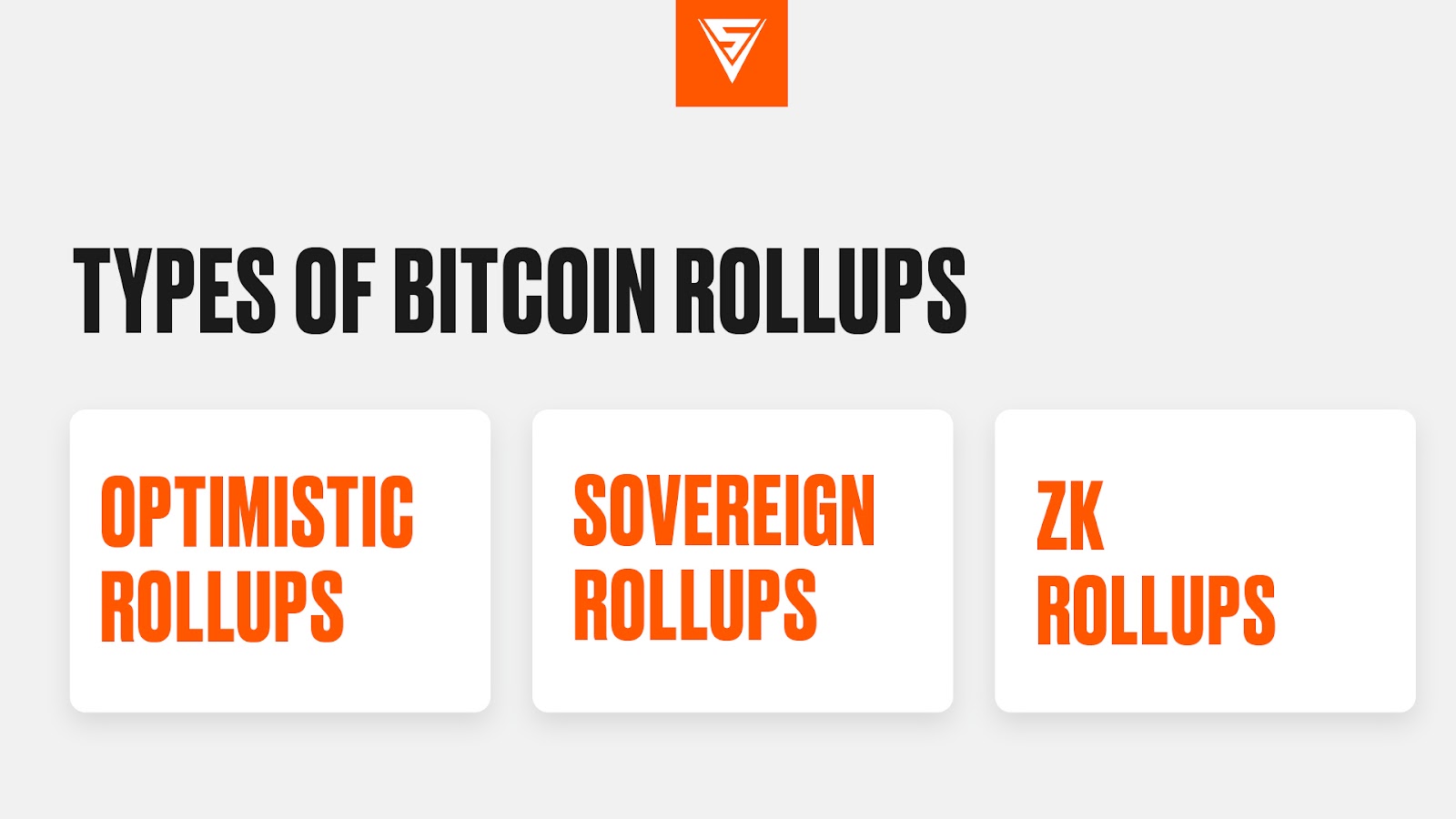
Bitcoin rollups are moving beyond theory into active development, but the two dominant cryptographic approaches—Optimistic and Zero-Knowledge (ZK)—offer fundamentally different tradeoffs for DeFi applications. Choosing between them requires weighing the speed of finality against the complexity of proof generation and the security guarantees provided by the underlying Layer 1.
Optimistic rollups operate on a simple premise: transactions are assumed valid unless proven otherwise. This approach mirrors how Ethereum’s early Layer 2 solutions scaled, allowing for high throughput with relatively low computational overhead. However, this convenience comes with a significant latency cost. Because any participant can challenge a fraudulent state transition during a dispute window (typically 7 days), users must wait for this period to pass before funds are considered fully settled on Bitcoin. This delay makes Optimistic rollups less suitable for high-frequency DeFi trading but effective for settlement layers where time is less critical.
| Feature | Optimistic Rollups | Zero-Knowledge (ZK) Rollups |
|---|---|---|
| Finality Speed | Slow (7-day challenge period) | Fast (minutes to hours) |
| Data Availability | Posted to L1 | Posted to L1 |
| Security Model | Depends on honest challenger | Cryptography-based |
| Complexity | Lower (EVM-compatible) | Higher (proof generation) |
| Bitcoin Fit | Good for settlement | Better for active trading |
Zero-Knowledge rollups, by contrast, use cryptographic proofs to validate transactions instantly. Every batch of transactions is accompanied by a validity proof that verifies its correctness against Bitcoin’s consensus rules. This eliminates the need for a challenge period, enabling near-instant finality. For DeFi protocols requiring rapid liquidity movement or arbitrage, ZK rollups provide the speed necessary to compete with centralized exchanges. The tradeoff is technical complexity; generating these proofs requires significant computational resources and specialized programming environments that are still maturing.
The choice between these models often depends on the specific DeFi use case. Optimistic rollups may serve as a cost-effective layer for long-term storage and settlement, leveraging Bitcoin’s security without the overhead of proof generation. ZK rollups, while more complex to build, offer the immediacy required for active financial markets. As Bitcoin rollups continue to evolve, we may see a hybrid ecosystem where both approaches coexist, each handling different segments of the DeFi landscape.
Why adoption is accelerating
Bitcoin rollups are moving from experimental prototypes to essential infrastructure as the network’s limitations become harder to ignore. The primary driver is simple: Layer 1 transaction fees have become prohibitively expensive for everyday DeFi interactions. When a basic swap costs more than the potential profit, the use case collapses. Rollups solve this by aggregating thousands of transactions off-chain and settling them as a single proof on Bitcoin, drastically reducing the cost per user while retaining the security of the main chain.
The rise of Bitcoin-native DeFi is the second major factor. Early Bitcoin DeFi relied on wrapped assets or sidechains, which often introduced counterparty risk or fragmented liquidity. Rollups offer a middle ground, enabling programmable money directly on or anchored to Bitcoin without compromising its security model. This shift allows developers to build complex financial instruments—like lending protocols and automated market makers—that were previously too slow or expensive to operate on the base layer.
Finally, the demand for programmable money is outpacing Bitcoin’s original design. While Bitcoin is excellent as a settlement layer, it lacks the native throughput for high-frequency applications. Rollups provide the necessary scalability, turning Bitcoin from a static store of value into a dynamic ecosystem for smart contracts and decentralized applications. This transition is critical for sustaining long-term growth in the Bitcoin economy.
Choosing the right Bitcoin rollup for your use case
Selecting a Bitcoin rollup requires balancing three competing priorities: security, speed, and cost. Unlike Ethereum L2s that inherit security directly from the main chain, Bitcoin rollups must address the unique constraints of the Bitcoin protocol. Your choice depends on whether you prioritize the immutability of the base layer, the transaction throughput of the rollup, or the liquidity depth of the ecosystem.
If you are moving significant value, choose a rollup that posts data directly to Bitcoin L1. This approach, often called a data availability layer, ensures that transaction proofs are anchored to the most secure blockchain in existence. While fees may be higher and settlement slower, you gain the strongest possible guarantee against censorship or fraud. This is the "rock" in the rock-or-hard-place trade-off.
For high-frequency trading or micro-transactions, look for rollups that use optimistic verification or rely on sequencers with lower data submission frequencies. These systems offload more computation off-chain, resulting in near-instant finality and fractions of a cent in fees. However, this speed comes with a trade-off: you are relying more on the integrity of the rollup operator than on the Bitcoin base layer.
A rollup is only as useful as the applications built on it. Check whether the rollup supports major DeFi primitives like lending, DEXs, or stablecoins. A vibrant ecosystem reduces friction when moving assets between L1 and L2. If a rollup lacks liquidity, you may face high slippage or long withdrawal times, negating the benefits of lower fees.
The decision often mirrors the classic trade-off between safety and efficiency. As noted in industry analyses, Bitcoin rollups face a "rock or hard place" dilemma: leaning too heavily on L1 security can stifle utility, while prioritizing speed can expose users to operator risk. Evaluate your specific use case against these factors before committing capital.
No comments yet. Be the first to share your thoughts!