
Bitcoin rollups in 2026: the current state
Bitcoin rollups are no longer just theoretical experiments. By 2026, the convergence of BitVM and OP_CAT has moved the technology from whitepapers to testnets, offering a clear path to scaling Bitcoin without sacrificing its core security model. The primary challenge remains bridging Ethereum’s execution environment with Bitcoin’s finality, but recent protocol upgrades have significantly narrowed the gap.
The scalability trilemma—balancing decentralization, security, and scalability—has long plagued Layer 2 solutions. Bitcoin rollups address this by leveraging existing Bitcoin consensus for data availability and settlement. BitVM allows for expressive computation without modifying the Bitcoin core, while OP_CAT enables more efficient contract execution. Together, they provide a framework that respects Bitcoin’s conservative upgrade philosophy while delivering the throughput modern applications require.
Market participants are closely watching these developments. As Bitcoin prepares for what some analysts predict could be its most significant volatility event of the year, the infrastructure supporting its ecosystem is equally critical. A robust rollup layer could attract institutional capital seeking yield on Bitcoin without leaving the network. The technical readiness of these rollups will likely influence how quickly this capital flows in.
The current landscape is defined by cautious optimism. While mainnet deployment timelines vary, the technical foundations are solid. Developers are focusing on interoperability and user experience, ensuring that rollups are not just fast, but also accessible. For investors and builders, understanding these mechanics is essential to navigating the next phase of Bitcoin’s evolution.
Bitcoin Rollups in 2026: Tradeoffs to Evaluate
As the 2026 landscape matures, Bitcoin rollups are no longer theoretical experiments but functional networks handling real transactions. However, the promise of scalability comes with distinct compromises. Choosing the right layer-2 solution requires weighing how each architecture balances security, developer experience, and capital efficiency.
The core tradeoff lies between native Bitcoin security and EVM compatibility. BitVM-based rollups offer a trust-minimized approach by allowing validators to dispute invalid state transitions, closely mirroring Bitcoin’s own security model. In contrast, OP_CAT-enabled chains often prioritize execution speed and familiar smart contract environments, sometimes relying on multi-signature setups or federated sequencers for initial security.
| Feature | BitVM Rollups | OP_CAT Chains | Native L2s |
|---|---|---|---|
| Security Model | Trust-minimized dispute game | Multi-sig or federated | Native Bitcoin consensus |
| EVM Compatibility | Limited or custom VMs | Full EVM support | Full EVM support |
| Finality Speed | Slower (dispute window) | Fast | Fast |
| Developer Tooling | Early stage, Rust-heavy | Mature, Solidity | Mature, Solidity |
Security remains the primary differentiator. BitVM approaches reduce reliance on trusted intermediaries, making them attractive for high-value institutional applications where censorship resistance is paramount. However, this comes at the cost of slower finality due to the challenge period required for dispute resolution. OP_CAT solutions, leveraging the newly activated opcode, enable more efficient smart contract execution but often introduce centralization risks during their early rollout phases.
For developers, the choice often hinges on tooling familiarity. OP_CAT chains benefit from the vast ecosystem of existing Ethereum tools, allowing for rapid deployment of DeFi protocols. BitVM projects are still refining their developer experience, focusing on specialized use cases like decentralized exchanges or oracle networks where Bitcoin-native security is non-negotiable. Native L2s like Stacks or Liquid offer a middle ground, providing enhanced functionality while maintaining a direct link to Bitcoin’s consensus layer.
Ultimately, there is no single "best" rollup. The optimal choice depends on your specific needs: prioritize BitVM for maximum security assurance, OP_CAT for EVM compatibility and speed, or native L2s for balanced performance. As these technologies converge in 2026, the lines between them will blur, but understanding these foundational tradeoffs is essential for navigating the evolving Bitcoin ecosystem.
How to Choose a Bitcoin Rollup Strategy
Bitcoin rollups are no longer theoretical. With BitVM proofs and OP_CAT enabling, the ecosystem has split into distinct paths. Each approach balances security, cost, and developer complexity differently. Use this framework to decide which rollup model fits your specific use case.

Optimistic rollups assume transactions are valid unless challenged. This model offers the highest level of security because it inherits Bitcoin’s finality without requiring complex zero-knowledge circuits. It is the best choice for high-value settlements or institutional custody solutions where trust minimization is non-negotiable. The trade-off is a seven-day withdrawal window, which limits capital efficiency for fast-moving applications.

Zero-knowledge rollups bundle transactions and submit a single cryptographic proof to the Bitcoin mainnet. This allows for near-instant finality and lower gas fees compared to layer-2 native tokens. ZK rollups are ideal for high-frequency trading, gaming, or consumer-facing applications that require speed. However, they demand significant computational resources to generate proofs and rely on trusted setup ceremonies that introduce initial centralization risks.
BitVM (Bitcoin Virtual Machine) allows arbitrary computations to be verified on Bitcoin without changing the consensus layer. It uses a fraud-proof system similar to optimistic rollups but with more flexible verification logic. This approach is suitable for developers who want to run complex smart contracts or connect Bitcoin to existing EVM ecosystems. It offers a middle ground between the security of ZK and the flexibility of optimistic models, though it is still in early experimental stages.
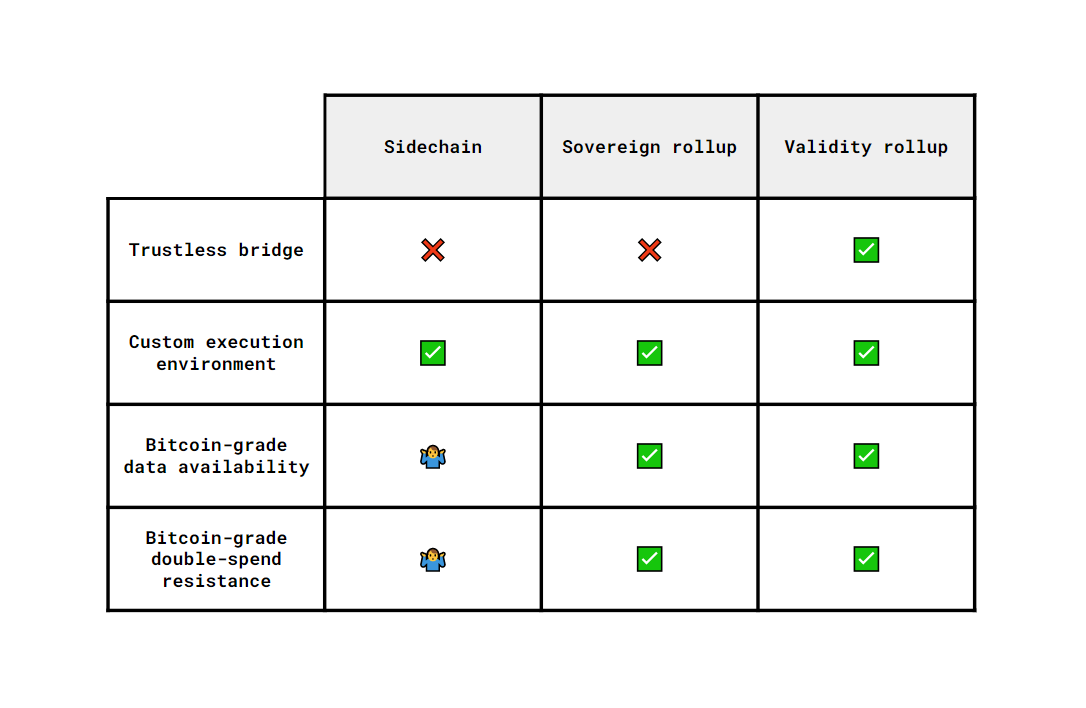
The technical model matters less than the available infrastructure. Check for active SDKs, audit reports, and community support before committing to a rollup. OP_CAT-enabled rollups offer greater programmability but require nodes to upgrade their software, which can slow adoption. BitVM solutions are more node-friendly but lack standardized tooling. Choose the platform where you can find experienced developers and audited smart contracts to ensure long-term viability.
Spotting Weak Bitcoin Rollup Options
Not every Bitcoin rollup is ready for prime time. As the ecosystem matures in 2026, distinguishing between robust infrastructure and speculative experiments becomes critical for developers and investors alike. The primary keyword cluster here revolves around identifying Bitcoin rollup risks and avoiding misleading claims that promise instant scalability without addressing the underlying trilemma.
The OP_CAT Hype Trap
OP_CAT is often touted as the silver bullet for Bitcoin scalability, but it is not a rollup itself. It is a soft fork proposal that enables opcode-level access to data. While this enables rollups like BitVM to function more efficiently, treating OP_CAT as a complete solution is a common mistake. It requires significant network consensus and carries high upgrade risks. If a project claims OP_CAT alone solves scalability, they are oversimplifying the architecture.
BitVM’s Complexity vs. Reality
BitVM offers a compelling trust-minimized approach, allowing complex computations on Bitcoin without changing the consensus layer. However, the setup complexity is substantial. Deploying a BitVM-based rollup involves intricate challenge-response mechanisms that can introduce latency. Projects that downplay this operational overhead are often misleading users about transaction finality times. Always check the technical documentation for specific latency benchmarks rather than relying on whitepaper promises.
Ignoring the Settlement Layer
A frequent oversight is neglecting the security of the settlement layer. Many rollups rely on Ethereum or other L1s for finality, which introduces cross-chain bridge risks. True Bitcoin-native rollups must prioritize settlement security on-chain. Evaluate whether the rollup’s security model aligns with Bitcoin’s immutable ledger or if it introduces unnecessary external dependencies that could compromise funds during market volatility.
Bitcoin rollups in 2026: frequently asked: what to check next
Bitcoin rollups are moving from experimental codebases to foundational infrastructure for the 2026 ecosystem. With BitVM and OP_CAT enabling new verification models, users and developers face distinct choices regarding security, cost, and liquidity. The following answers address the most practical objections before committing capital or code to a Layer 2 solution.
No comments yet. Be the first to share your thoughts!