
Bitcoin rollups 2026 limits to account for
Bitcoin rollups are in their earliest production phase, shifting from theoretical design to live mainnets. The primary constraint in 2026 is not technical feasibility, but the immature ecosystem state. Projects like Citrea launched their mainnets in early 2026 with modest total value locked (TVL), signaling that while the infrastructure is live, liquidity and developer adoption remain in the seed stage.
The core value proposition remains solving Bitcoin's throughput and finality issues without sacrificing security. By batching transactions off-chain and posting proofs to Bitcoin, these Layer 2 solutions aim to offer Ethereum-like speeds with Bitcoin-level settlement guarantees. However, users must plan around the tradeoffs between different rollup architectures, such as optimistic versus zero-knowledge proofs, which impact speed, cost, and decentralization.
Current comparisons highlight key players like Citrea, BOB, and Starknet, each offering distinct approaches to integrating with Bitcoin. The decision on which rollup to use depends heavily on specific use cases: high-frequency trading requires low-latency finality, while long-term storage prioritizes maximum security and decentralization. As the ecosystem matures, these constraints are expected to ease, but for now, careful evaluation of each platform's maturity is essential.
Bitcoin rollup tradeoffs in 2026
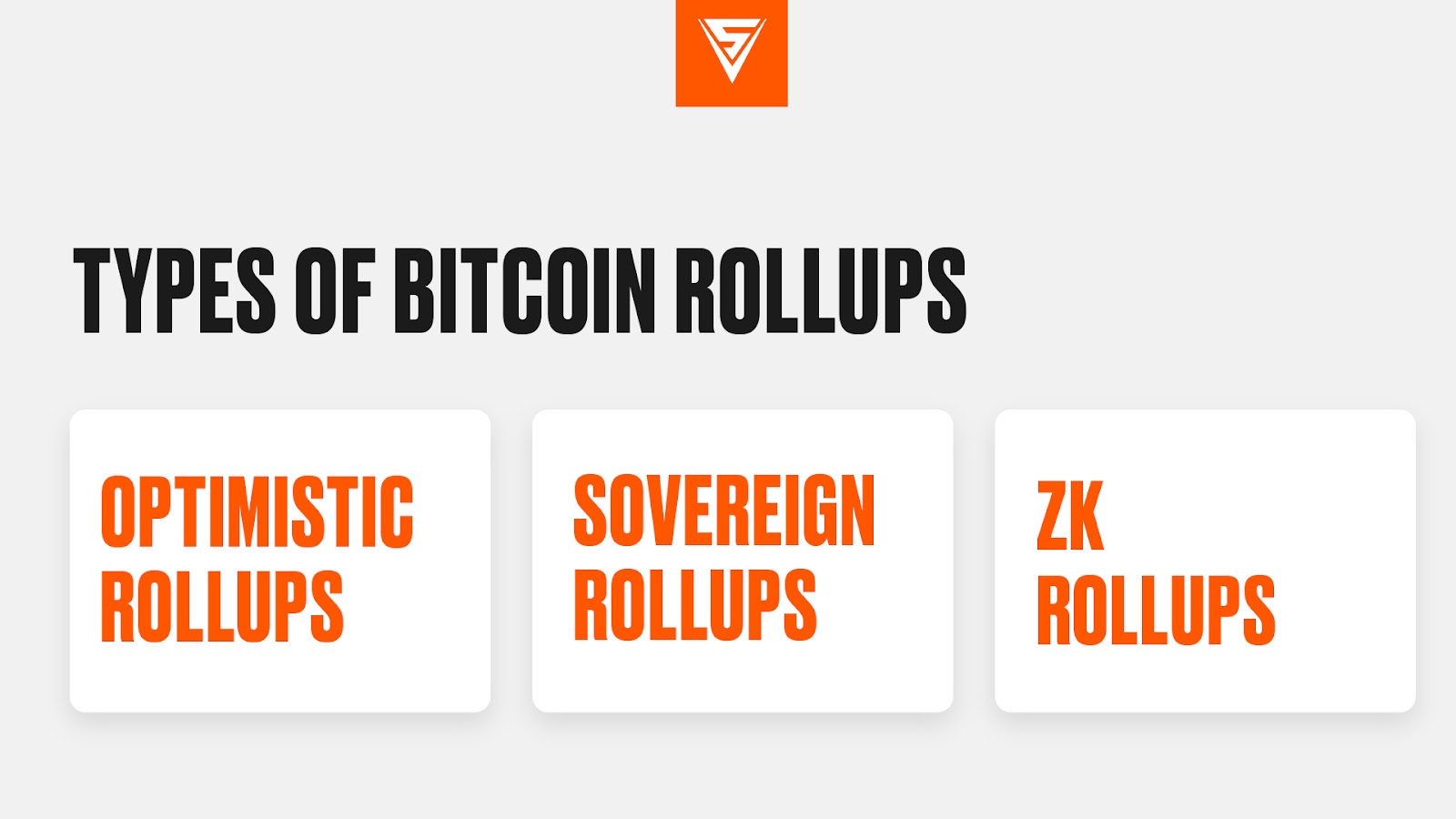
Choosing a Bitcoin rollup in 2026 requires balancing speed against security assumptions. Unlike Ethereum, Bitcoin’s consensus mechanism does not natively support complex smart contracts, so rollups must bridge this gap using different cryptographic proofs. The primary tradeoff lies in the type of validity proof used: zk-Rollups offer strong security guarantees similar to Bitcoin itself, while optimistic Rollups rely on dispute periods that delay finality but reduce costs.
When evaluating these options, look beyond advertised transaction speeds. The real differentiator is how the rollup handles data availability and fault detection. A system might process 10,000 transactions per second, but if the data is not securely anchored to the Bitcoin blockchain, the security model collapses. You must also consider the economic incentives: are sequencers centralized, or is there a competitive block-building market?
The table below compares the most prominent Bitcoin rollups launching in 2026, including Citrea, BOB, and Starknet’s Bitcoin integration. These projects represent the current state of the art, each making distinct choices about decentralization, finality time, and developer experience.
| Rollup | Proof Type | Finality | TVL (Est.) |
|---|---|---|---|
| Citrea | zk-SNARK | ~10 mins | $1.7M |
| BOB | Optimistic | 7 days | $12M |
| Starknet BTC | zk-STARK | ~20 mins | $8.5M |
| Succinct | zk-Rollup | ~15 mins | $3.2M |
For investors and developers, the decision often comes down to risk tolerance. If you prioritize immediate, low-cost transactions and trust the sequencer, optimistic rollups like BOB may offer better UX. However, for capital-intensive applications like DeFi, zk-Rollups provide a stronger security posture by relying on mathematical proofs rather than a challenge period. This distinction is critical as the Bitcoin ecosystem matures beyond simple value transfer.
Ultimately, no single rollup is perfect. The landscape is fragmented, and standards are still evolving. In 2026, the best approach is to match the rollup to your specific use case: high-frequency trading might favor optimistic chains, while long-term storage and settlement should lean toward zk-based architectures that align more closely with Bitcoin’s immutable nature.
Choose the next step
Bitcoin Rollups works best as a clear sequence: define the constraint, compare the realistic options, test the tradeoff, and choose the path with the fewest hidden costs. That order keeps the advice usable instead of decorative. After each step, pause long enough to check whether the recommendation still fits the reader's actual situation. If it depends on perfect timing, unusual access, or a best-case budget, include a simpler fallback.
Watchouts: Weak Options and Misleading Claims
Bitcoin rollups are still in their earliest production phase, making them vulnerable to inflated narratives. Citrea launched its mainnet in January 2026 with approximately $1.7 million in TVL, a figure that highlights the sector's nascent stage rather than its maturity. When evaluating options, treat these metrics as early indicators, not proof of stability.
Avoid projects that promise seamless user experiences without transparent data availability proofs. Many "industry rollups" are still experimenting with settlement layers, meaning your funds may be exposed to higher withdrawal risks. Check the specific bridge mechanisms; if the documentation is vague, the risk is real.
Don't assume that a high Total Value Locked (TVL) equals security. In this market, TVL often reflects speculative activity rather than robust infrastructure. Stick to protocols with audited code and clear, public dispute resolution processes. If a rollup cannot clearly explain how it handles invalid state transitions, it is not ready for serious capital.
Bitcoin rollups 2026: what to check next
The Bitcoin rollup landscape in 2026 is defined by rapid infrastructure deployment rather than speculative hype. Projects like Citrea have already launched mainnets, signaling a shift from theory to production. Below are direct answers to the most common questions about market timing, price predictions, and asset selection.
No comments yet. Be the first to share your thoughts!