
Bitcoin rollups 2026 market context
The 2026 crypto landscape is defined by a shift from speculative liquidity to structural onchain utility. As noted in industry outlooks from firms like Bitcoin Suisse and Kraken, the current cycle is driven by shifting liquidity flows and emerging onchain innovation rather than pure momentum trading. This macroeconomic backdrop creates a specific demand for infrastructure that can handle high throughput without compromising the security guarantees of the base layer.
Bitcoin rollups have emerged as the primary vehicle for meeting this demand. While simple payments remain the baseline use case, the market context of 2026 favors solutions that enable complex smart contracts and decentralized applications. Rollups allow developers to batch transactions off-chain and post compressed proofs to Bitcoin, effectively scaling the network while inheriting its settlement security. This architectural choice addresses the bottleneck that has historically limited Bitcoin’s utility beyond store-of-value.
The technical viability of this approach is supported by recent advancements in zero-knowledge proof systems and optimistic verification mechanisms. These technologies reduce the cost of data availability and settlement, making rollups economically feasible for both retail and institutional users. As liquidity continues to migrate toward these scalable layers, the distinction between Bitcoin as a settlement layer and Bitcoin as an application layer becomes increasingly blurred, setting the stage for a more robust ecosystem.
How Bitcoin rollups work technically
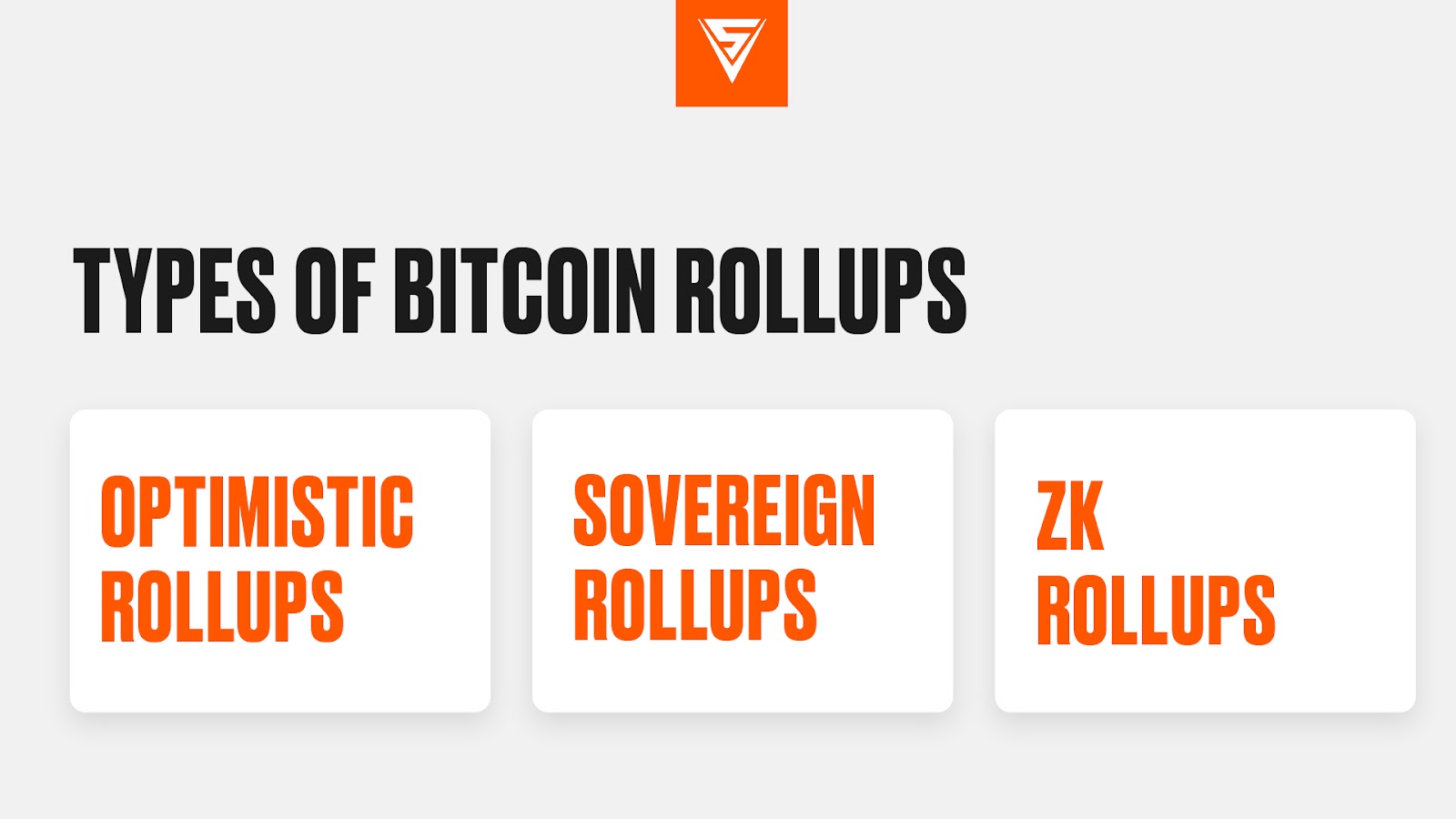
Bitcoin rollups bundle transactions off-chain and submit a single proof to the mainnet, allowing the network to scale without sacrificing its core security model. Rather than processing every transaction on the base layer, rollups rely on three distinct architectural approaches: Optimistic, Zero-Knowledge (ZK), and Sovereign. Each method balances the trade-offs between execution speed, security guarantees, and decentralization differently.
Optimistic rollups
Optimistic rollups assume all transactions are valid by default and only require verification if a challenger disputes the result. This approach minimizes computational overhead during normal operation, making it faster and cheaper to execute transactions. However, it introduces a withdrawal delay—typically seven days—during which users must wait for the "challenge period" to expire before they can move funds back to the mainnet. This delay is the price paid for lower computational costs and higher throughput.
Zero-Knowledge (ZK) rollups
ZK rollups generate a cryptographic proof for every batch of transactions, which the Bitcoin mainnet verifies before accepting the state update. This method provides immediate finality, allowing users to withdraw funds much faster than with Optimistic models. The trade-off is significant computational complexity; generating these proofs requires specialized hardware and more intensive processing, which can increase the cost per transaction. As ZK technology matures, these computational costs are expected to decrease, making this approach increasingly viable for high-frequency applications.
Sovereign rollups
Sovereign rollups prioritize decentralization by allowing validators to independently verify transaction validity without relying on a centralized sequencer or complex cryptographic proofs. This model offers greater censorship resistance and aligns closely with Bitcoin’s original ethos of permissionless validation. However, it often sacrifices some degree of scalability and ease of use, as the verification process can be more resource-intensive for individual nodes. Sovereign rollups represent a philosophical choice to favor security and decentralization over raw speed.
Leading Bitcoin L2 projects in 2026
The Bitcoin Layer 2 ecosystem has matured from experimental testnets to a diverse array of protocols, each solving distinct scalability and functionality problems. As of 2026, the landscape is defined by three primary architectural approaches: optimistic rollups, zero-knowledge (ZK) rollups, and sovereign rollups. Each type offers different trade-offs in terms of security assumptions, transaction finality, and compatibility with existing Ethereum Virtual Machine (EVM) tooling.
To understand where value is flowing, it is helpful to compare the leading projects by their technical stack and current market position. The table below outlines the core characteristics of the most significant Bitcoin L2s.
| Project | Rollup Type | TVL Status | Key Feature |
|---|---|---|---|
| Stacks | Optimistic | High | Smart contracts & DeFi |
| Rootstock (RSK) | Optimistic | High | EVM compatibility |
| Lightning Network | State Channel | High (Liquidity) | Instant micropayments |
| Liquid Network | Sidechain | High | Asset issuance & trading |
| Citrea | ZK Rollup | Growing | Native BTC collateral |
| Bitlayer | ZK Rollup | Growing | Parallel execution |
Stacks and Rootstock remain the dominant force in Bitcoin DeFi. Stacks uses a unique Nakamoto Consensus upgrade to improve block times, while Rootstock offers a fully EVM-compatible environment for developers migrating from Ethereum. Lightning Network continues to lead in pure transaction throughput for payments, though it lacks the smart contract complexity of rollups.
The new wave of ZK rollups, including Citrea and Bitlayer, is gaining traction by offering faster finality and lower fees. Citrea focuses on native Bitcoin collateralization, allowing users to interact with DeFi without wrapping BTC. Bitlayer emphasizes parallel execution to handle high-throughput applications. These projects are still in the growth phase but represent the cutting edge of Bitcoin scalability.
DeFi adoption and liquidity trends
Bitcoin rollups are shifting from experimental infrastructure to active liquidity hubs. As these layer-2 networks mature, they are beginning to siphon capital from Ethereum, where transaction costs and congestion have historically priced out smaller participants. This migration is not merely about seeking cheaper gas; it is about accessing Bitcoin’s vast, underutilized treasury through native financial instruments.
The emergence of Bitcoin-native DeFi products—such as wrapped BTC yield farms and decentralized lending protocols—creates a new asset class that does not rely on Ethereum’s security model. Liquidity is flowing toward these ecosystems because they offer exposure to Bitcoin’s upside while enabling composability similar to what is found in the Ethereum Virtual Machine (EVM). This trend is reshaping the broader crypto market, as capital seeks real revenue capture over speculative hype, a shift noted in recent market analyses for 2026.
Evaluate Bitcoin L2 Security and Risks
Bitcoin rollups introduce a complex layer of abstraction that separates execution from settlement. This architecture creates unique attack vectors that do not exist on the base layer. Users must understand that the security of their funds depends entirely on the integrity of the rollup’s bridge and data availability mechanisms.
The primary risk lies in the bridge connecting Bitcoin to the L2. If the bridge’s smart contract or multisig setup is compromised, funds can be drained regardless of the rollup’s internal security. Always verify the bridge’s source code and audit history through official channels. Relying on third-party summaries or unverified blog posts can lead to catastrophic losses.
Data availability is the second critical factor. If a rollup fails to publish transaction data on Bitcoin, users cannot prove ownership of their assets. This creates a "data availability attack" where the rollup operator can freeze withdrawals indefinitely. Projects that use Bitcoin’s native OP_RETURN or taproot assets for data availability offer stronger guarantees than those relying on centralized sequencers.

No comments yet. Be the first to share your thoughts!