

As Bitcoin hovers around $68,437.00 amid a 5.74% 24-hour surge, its scalability infrastructure faces mounting pressure from institutional adoption and DeFi ambitions. In this macro landscape, where global liquidity cycles amplify digital asset demand, zkBTC rollups and sovereign rollups emerge as pivotal Bitcoin scaling 2026 contenders. These Layer-2 protocols promise to unshackle BTC's base layer, processing thousands of transactions off-chain while anchoring security to Bitcoin's unyielding consensus. Yet, their philosophies diverge sharply: one leans on cryptographic purity, the other on sovereign flexibility.
zkBTC Rollups: Zero-Knowledge Proofs as Bitcoin's Security Anchor
At the heart of zkBTC rollups lies zero-knowledge proofs, a cryptographic wizardry that batches transactions off-chain and compresses them into succinct validity proofs posted to Bitcoin's Layer-1. This isn't mere optimism; it's mathematical certainty. Transactions execute privately, with proofs like zk-SNARKs or zk-STARKs ensuring correctness without exposing details, preserving Bitcoin's privacy ethos amid rising surveillance risks.
Consider the throughput leap: recent zkBTC implementations hit 71 transactions per second in DeFi apps, dwarfing Bitcoin's native 7 TPS. Capital efficiency shines too, with withdrawals finalizing in minutes versus hours for optimistic alternatives. But this power draws from Bitcoin's consensus for finality, introducing a deliberate latency trade-off for unmatched trustlessness. In a world of geopolitical volatility, where Bitcoin must rival gold's safe-haven status at $68,437.00, this security model fortifies macro resilience.
ZK Rollups finalize withdrawals in minutes to provide superior capital efficiency compared to Optimistic Rollups.
Read more on how these proofs revolutionize throughput in our guide: How zkBTC Rollups Revolutionize Bitcoin Scalability.
zkBTC Rollups vs Sovereign Rollups vs Bitcoin L1: Key Differences for Scaling in 2026 (BTC at $68,437)
| Feature | zkBTC Rollups | Sovereign Rollups | Bitcoin L1 |
|---|---|---|---|
| Data Availability 🗄️ | Bitcoin L1 (ZK proofs + calldata) | Bitcoin blocks (DA only) | Full Bitcoin blocks |
| Execution 🖥️ | Off-chain with ZK proofs verified on Bitcoin | Custom consensus mechanism | Limited Script |
| Fees 💰 | Low (batched + proof verification) | Sub-cent 🚀 | Higher (variable) |
| Finality Speed ⏱️ | Minutes (ZK validity proofs) | Fast (internal consensus) | Hours/Days (multiple confirmations) |
| Flexibility 🔧 | EVM-compatible + privacy | Bespoke VMs & custom envs | Basic transfers only |
| Security 🔒 | Inherited from Bitcoin consensus | Shifted to rollup's consensus | Bitcoin consensus |
| TPS (2026) 📈 | Up to 71 TPS in DeFi | High throughput (faster confirmations) | ~7 TPS |
| dApps Unlocked 🌐 | DeFi, privacy-preserving apps | Complex smart contracts & custom dApps | Simple payments |
Unpacking the Architectural Fault Lines
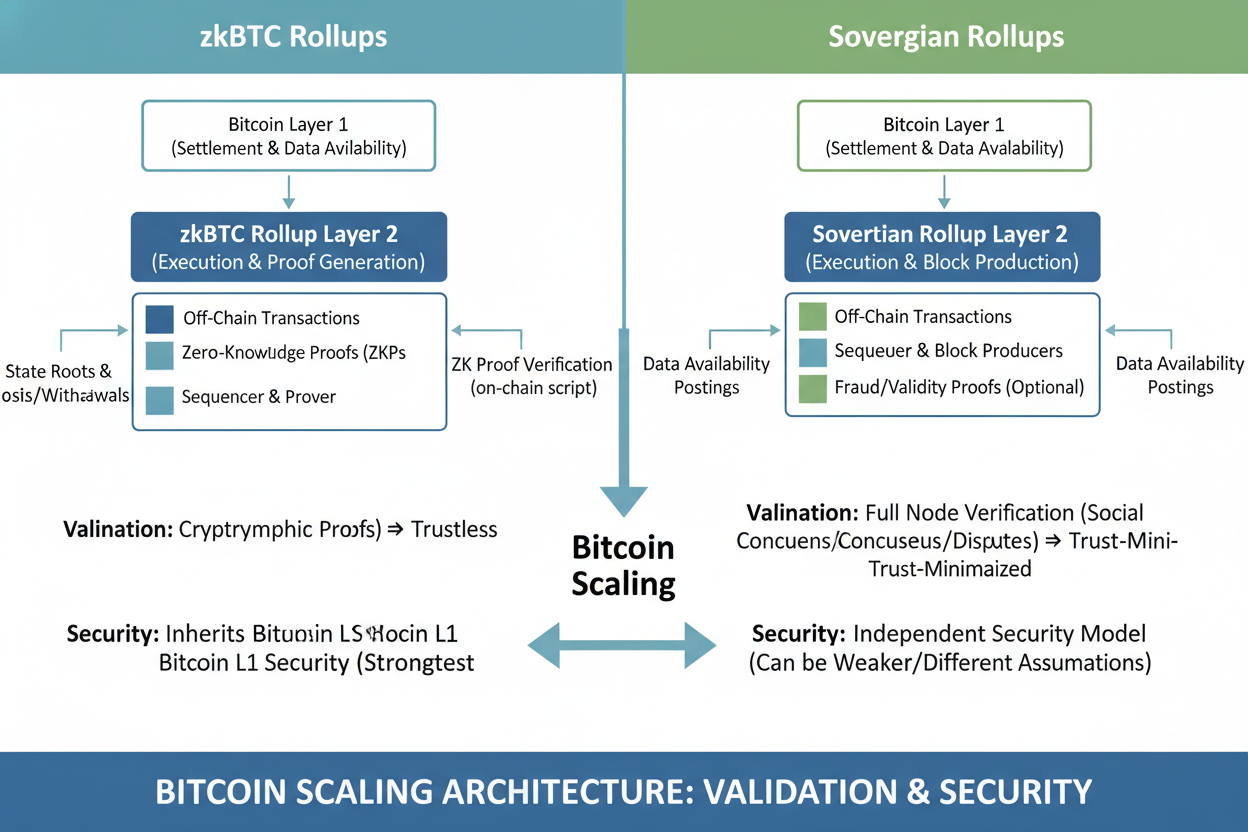
The chasm between zero-knowledge proofs Bitcoin and sovereign designs boils down to validation locus. zkBTC rollups submit proofs for L1 scrutiny, inheriting Bitcoin's hashpower and decentralization fully. Sovereigns, conversely, validate internally, using Bitcoin solely for dispute data, which accelerates but decentralizes less rigorously.
| Aspect | zkBTC Rollups | Sovereign Rollups |
|---|---|---|
| Validation | Bitcoin L1 proofs | Internal consensus |
| Security | Inherits BTC fully | Rollup-dependent |
| Speed/Fees | Minutes, efficient | Instant, cheapest |
| Flexibility | ZK-constrained | Highly customizable |
This table underscores trade-offs: zkBTC prioritizes Bitcoin L2 protocols purity, while sovereign rollups on Bitcoin chase velocity. Macro tailwinds favor both; surging prices signal demand for scalable rails handling trillions in value.
Bitcoin (BTC) Price Prediction 2027-2032: zkBTC Rollups vs Sovereign Rollups Impact
Forecasts based on scaling advancements, adoption trends, and market cycles as of 2026 ($68,437 baseline)
| Year | Minimum Price | Average Price | Maximum Price | YoY % Change (Avg) |
|---|---|---|---|---|
| 2027 | $55,000 | $85,000 | $130,000 | +24% |
| 2028 | $70,000 | $110,000 | $170,000 | +29% |
| 2029 | $90,000 | $140,000 | $220,000 | +27% |
| 2030 | $120,000 | $180,000 | $280,000 | +29% |
| 2031 | $150,000 | $230,000 | $350,000 | +28% |
| 2032 | $200,000 | $300,000 | $450,000 | +30% |
Price Prediction Summary
Bitcoin prices are projected to grow progressively from 2027-2032 due to zkBTC Rollups providing secure, privacy-enhanced scaling (prioritizing Bitcoin consensus validation) and Sovereign Rollups offering flexible, high-speed autonomy. Minimums reflect bearish corrections amid regulatory risks; averages assume steady adoption; maximums capture bullish DeFi boom and institutional inflows. Overall bullish outlook with 4x growth potential by 2032.
Key Factors Affecting Bitcoin Price
- Scalability boost: zkBTC up to 71 TPS vs Bitcoin native, Sovereign faster/cheaper via independent consensus
- Adoption surge in DeFi/apps on Bitcoin L2s, driving transaction volume
- Halving cycle tailwinds post-2024, next in 2028 amplifying scarcity
- Regulatory progress favoring compliant rollups, reducing uncertainty
- Macro factors: ETF inflows, inflation hedge; competition from Ethereum L2s
- Risks: Rollup security breaches (Sovereign trust model), market volatility
Disclaimer: Cryptocurrency price predictions are speculative and based on current market analysis. Actual prices may vary significantly due to market volatility, regulatory changes, and other factors. Always do your own research before making investment decisions.
Delving deeper, zkBTC's proof generation, though computationally intense, aligns with hardware advances, potentially slashing costs 10x by year-end. Sovereigns sidestep this via lighter mechanisms, but face sequencer centralization risks unless prover networks mature swiftly.
Sovereign rollups Bitcoin appeal to builders craving bespoke virtual machines, unhindered by Bitcoin's script limitations. This autonomy unlocks exotic dApps, from high-frequency trading bots to privacy-centric mixers, all settled via Bitcoin's data availability for dispute resolution. Yet, in sequencer bottlenecks, they mirror Ethereum's early L2 pains, where single points of failure throttle scalability during peaks. As Bitcoin climbs to $68,437.00, these friction points test rollup maturity against real-world volume spikes.
Risks and Challenges Shaping Adoption Trajectories
Zero-knowledge proofs Bitcoin demand rigorous hardware, with proof recursion still nascent on Bitcoin's constrained opcodes. Quantum threats loom distantly, but STARKs offer post-quantum resilience, a macro hedge as nation-states eye crypto disruption. Sovereign rollups Bitcoin shift trust to rollup operators, inviting governance attacks unless decentralized sequencers proliferate. Data availability costs on Bitcoin, post-2024 upgrades, remain premium, pressuring both to optimize calldata compression.
| Risk Factor | zkBTC Rollups Impact | Sovereign Rollups Impact |
|---|---|---|
| Centralization | Low - BTC consensus | Medium - Sequencer reliance |
| Proof Costs | High initially | Negligible |
| Finality Latency | Minutes | Seconds |
| MEV Exposure | Mitigated by ZK | Higher in custom VMs |
These vulnerabilities underscore a bifurcated path: zkBTC rollups fortify Bitcoin L2 protocols for institutional vaults, where liveness trumps speed, while sovereign variants fuel retail DeFi explosions, betting on community oversight. In 2026's liquidity-fueled bull, hybrid models may bridge gaps, blending ZK validity with sovereign execution.
2026 Horizon: Projects and Macro Catalysts
Emerging zkBTC rollups like those teased on zkrollups. io eye 1,000 TPS milestones, leveraging Bitcoin's Taproot for efficient proof anchoring. Sovereign challengers, per Blockworks insights, prioritize sub-cent fees, carving niches in gaming and socialFi where user experience reigns. Bitcoin scaling 2026 hinges on these: zkBTC for sovereign-grade security, sovereign rollups for Ethereum-like expressiveness without EVM baggage.
Macro cycles amplify stakes. With Bitcoin at $68,437.00 and 5.74% daily gains signaling ETF inflows, rollups must handle quadrillion-dollar throughput dreams. zkBTC's privacy edge counters regulatory headwinds, while sovereign flexibility invites nation-state pilots in emerging markets. Developers face a choice: inherit Bitcoin's fortress or build sovereign kingdoms atop its data moat.
Ultimately, zkBTC rollups anchor Bitcoin's ascent as digital gold, their proofs a bulwark against fragility. Sovereign rollups Bitcoin ignite programmable frontiers, trading some purity for velocity. As global capital rotates into BTC amid economic flux, both propel Bitcoin scaling 2026 toward mass viability, each carving complementary realms in the protocol's expansive future.




No comments yet. Be the first to share your thoughts!