


On January 27,2026, Citrea flipped the switch on its mainnet, delivering the first fully operational Bitcoin rollups mainnet and marking a pivotal moment for BTC scaling solutions. Backed by heavyweights like Founders Fund and Galaxy Ventures, this Bitcoin-based ZK-rollup introduces DeFi primitives such as trading, lending, and settlement directly atop Bitcoin’s base layer. Amid Bitcoin’s current price of $78,106.00 – down 7.05% in the last 24 hours from a high of $84,140.00 – Citrea’s launch injects fresh utility into BTC, potentially stabilizing demand through non-payment use cases like stablecoins and wrapped assets.

Citrea Ignites First BTC Rollup Live
Citrea’s mainnet rollout cements it as the first BTC rollup architecture to achieve production status. Unlike Ethereum’s rollups, which benefited from a smart contract-friendly EVM, Bitcoin’s UTXO model demanded novel engineering. Citrea operates as a zero-knowledge rollup: transactions execute off-chain at scale, with cryptographic proofs batched and settled on Bitcoin L1. This setup preserves Bitcoin’s censorship resistance while unlocking Layer 2 throughput.
The project launches with cBTC, a trust-minimized wrapped Bitcoin that mirrors native BTC 1: 1 via ZK validity proofs. Complementing it is ctUSD, MoonPay-issued stablecoin pegged to cash and short-term U. S. Treasuries. Initial DeFi liquidity targets $50 million, seeding markets for lending protocols and perpetuals. Developers now bridge BTC seamlessly, deploying apps without forking Bitcoin’s core ethos.
This isn’t vaporware. Citrea’s sequencer posts state roots to Bitcoin, enabling anyone to verify the rollup’s integrity. Fraud proofs aren’t needed; ZK succinctness ensures validity. For traders eyeing Bitcoin layer 2 mainnet opportunities, Citrea offers a sandbox where BTC fuels sophisticated strategies, from yield farming to options vaults – aligning with my mantra: protect downside, let winners run.

Bitcoin Rollups: From Theory to zkBTC Reality
Rollups bundle hundreds of transactions off-chain, compressing them into a single Bitcoin inscription or commitment. Picture a single UTXO holding aggregated user balances, updated via periodic settlements. This mirrors optimistic rollups on Ethereum but leverages Bitcoin’s security model. Citrea advances further with ZK proofs, eliminating withdrawal delays inherent in challenge periods.
Historical context underscores the grind. Projects like BitVM sketched rollup blueprints, but Bitcoin’s script limitations stalled progress. Taproot upgrades cracked the door, enabling Schnorr signatures for efficient multi-sig and aggregation. Citrea threads this needle: its prover generates proofs compatible with Bitcoin’s opcodes, posting data availability directly to blocks. No sidechains; pure Bitcoin finality.
BTC scaling solutions zkBTC like Citrea sidestep L1 congestion. Bitcoin processes 7 TPS natively; rollups target thousands. Sequencers order txs, execute in a Bitcoin VM, and prove state transitions. Users deposit BTC, trade in the rollup, and withdraw with a validity proof – burned on L1 for force execution. This architecture unlocks DeFi without compromising sovereignty.
Dissecting Citrea’s Rollup Engine
At its core, Citrea’s Citrea BTC rollup architecture hinges on a custom zkVM tuned for Bitcoin scripts. Off-chain, a RISC-V like machine simulates UTXO spends, producing execution traces. The zk-SNARK prover compresses these into a 1KB proof, anchored via OP_RETURN or inscriptions. Bitcoin acts as the settlement layer, storing commitments and enforcing exits.
Key innovation: STUTXO model. Traditional UTXOs are stateless; Citrea introduces stateful trees merklized into a global UTXO set. Balances live off-chain, rooted on L1. For censorship resistance, anyone can replicate the state from Bitcoin data alone – no trusted nodes required. Sequencer failures trigger permissionless escapes, where users submit ZK proofs to reclaim funds.
Performance metrics impress: sub-second finality off-chain, 100x L1 costs savings. With Bitcoin at $78,106.00, bridging $50 million liquidity positions Citrea as a DeFi hub. Yet debates rage: does DeFi bloat block space? Proponents argue sustained fees bolster security; skeptics cling to payments purity. I lean toward expansion – Bitcoin’s scarcity amplifies utility value.
Bitcoin (BTC) Price Prediction 2027-2032
Long-term outlook post-Citrea mainnet launch (Jan 27, 2026), factoring in Bitcoin rollups, DeFi expansion, and market cycles from current price of $78,106
| Year | Minimum Price | Average Price | Maximum Price | Avg YoY % Change |
|---|---|---|---|---|
| 2027 | $100,000 | $140,000 | $200,000 | +47% (from proj. 2026 avg $95K) |
| 2028 | $150,000 | $220,000 | $320,000 | +57% |
| 2029 | $220,000 | $320,000 | $450,000 | +45% |
| 2030 | $300,000 | $450,000 | $650,000 | +41% |
| 2031 | $420,000 | $620,000 | $900,000 | +38% |
| 2032 | $580,000 | $850,000 | $1,200,000 | +37% |
Price Prediction Summary
Bitcoin’s price is forecasted to surge post-Citrea launch, unlocking DeFi and scaling via ZK-rollups. Short-term (post-launch): 7 days avg ~$82,000 (volatile rebound), 30 days ~$92,000, 90 days ~$105,000. Long-term: averages climb from $140K (2027) to $850K (2032) amid adoption, halvings, and utility growth, with bearish mins reflecting corrections and bullish maxes capturing hype cycles.
Key Factors Affecting Bitcoin Price
- Citrea mainnet launch with $50M DeFi liquidity and cBTC/ctUSD
- Bitcoin rollups enabling scalable DeFi, lending, trading on BTC
- 2028 halving increasing scarcity
- Institutional adoption and BTC L2 TVL growth
- Regulatory clarity on BTC L2s vs. traditional focus
- Macro trends, market cycles, and competition from ETH/Solana
- Tech upgrades like BitVM enhancing smart contracts
Disclaimer: Cryptocurrency price predictions are speculative and based on current market analysis.
Actual prices may vary significantly due to market volatility, regulatory changes, and other factors.
Always do your own research before making investment decisions.
Bridging mechanics further solidify trustlessness. Deposits lock BTC in a multisig or covenant; withdrawals prove inclusion via ZK. No oracles; pure crypto-economic guarantees. This STUTXO Bitcoin rollup paradigm sets a template for competitors, pressuring chains like Stacks or Lightning to evolve.
Security audits underpin this robustness. Citrea underwent multiple reviews from firms like Trail of Bits, confirming prover soundness and no single points of failure. Sequencer decentralization roadmap targets Cosmos SDK integration by Q2 2026, distributing ordering power. For now, a permissioned sequencer bootstraps liquidity, transitioning via economic incentives.
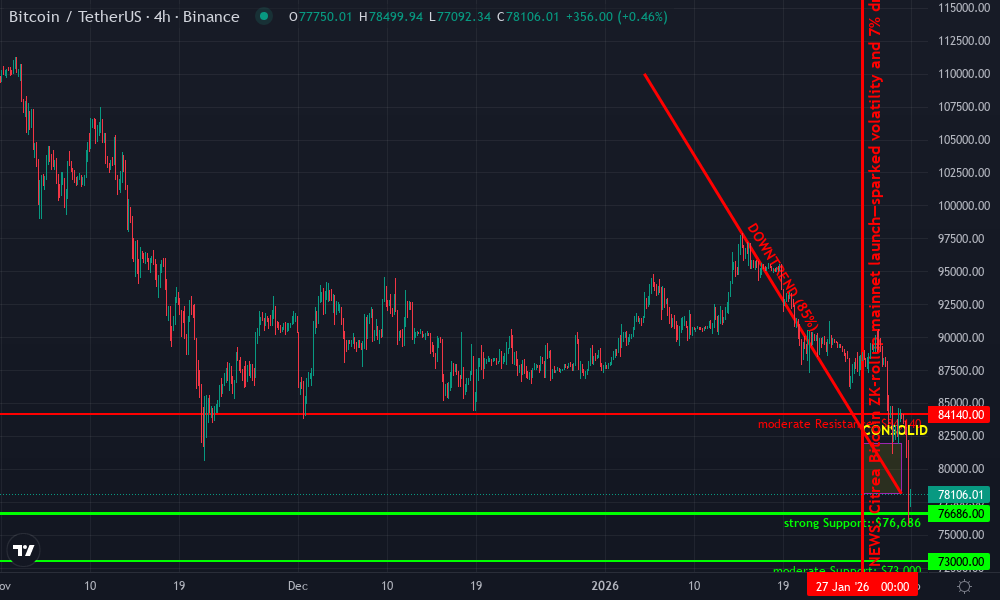
Bitcoin Technical Analysis Chart
Analysis by Derek Fulton | Symbol: BINANCE:BTCUSDT | Interval: 4h | Drawings: 6
Technical Analysis Summary
On this BTCUSDT daily chart spanning late December 2025 into early February 2026, draw a primary downtrend line connecting the swing high at approximately $110,000 on 2026-01-05 to the recent swing low near $78,106 as of 2026-01-31, using the ‘trend_line’ tool with red color for bearish bias. Add horizontal support at $76,686 (recent 24h low, strong level) and resistance at $84,140 (24h high). Mark a consolidation rectangle from 2026-01-27 to 2026-01-31 between $78,000-$82,000. Place a vertical line at 2026-01-27 for the Citrea mainnet launch news event. Use arrow_mark_down on MACD bearish signal around 2026-01-28 and callout on declining volume pattern. Entry zone horizontal at $78,500 for potential long bounce with tight stop below $76,686. Exit profit target $82,000, stop loss $76,000. Emphasize low-risk setups only, protecting downside per my rules-based framework.
Risk Assessment: high
Analysis: Sharp 7% drop on high volatility post-news, downtrend intact, low volume support raises breakdown risk—my quant models flag elevated short-term risk
Derek Fulton’s Recommendation: Stay sidelined or use options for defined-risk long bias only. Protect downside, let winners run—wait for bullish confirmation.
Key Support & Resistance Levels
📈 Support Levels:
-
$76,686 – Recent 24h low, strong psychological and technical support post-drop
strong -
$73,000 – Prior swing low extension, moderate hold if breached
moderate
📉 Resistance Levels:
-
$84,140 – 24h high, immediate overhead resistance from recent rejection
moderate -
$85,000 – Consolidation ceiling from mid-January, weaker on low volume
weak
Trading Zones (low risk tolerance)
🎯 Entry Zones:
-
$78,500 – Bounce entry above current price if support holds, confirmed by volume spike—low risk tolerance demands tight risk
low risk
🚪 Exit Zones:
-
$82,000 – Initial profit target at minor resistance, scale out 50%
💰 profit target -
$76,000 – Hard stop loss below key support to protect downside
🛡️ stop loss
Technical Indicators Analysis
📊 Volume Analysis:
Pattern: declining on downside
Bearish divergence—volume fading on drop suggests weakening sellers, potential exhaustion
📈 MACD Analysis:
Signal: bearish crossover
MACD line below signal with histogram contracting negative, confirming downtrend momentum
Applied TradingView Drawing Utilities
This chart analysis utilizes the following professional drawing tools:
Disclaimer: This technical analysis by Derek Fulton is for educational purposes only and should not be considered as financial advice.
Trading involves risk, and you should always do your own research before making investment decisions.
Past performance does not guarantee future results. The analysis reflects the author’s personal methodology and risk tolerance (low).
Opposition persists. Purists decry non-payment data as bloat, fearing Miner Extractable Value spikes. Yet empirical data from Ordinals era shows demand elasticity: fees peaked then normalized, funding hashrate growth. Citrea’s ZK compression minimizes footprint, prioritizing sovereignty over EVM compatibility.
Beyond Citrea: zkBTC Ecosystem Surge
Citrea pioneers, but rivals lurk. BitVM2 refines optimistic variants; Sovereign Rollups explore fractal scaling. Stacks’ sBTC bridges Clarity contracts, yet lacks ZK succinctness. Lightning excels for micropayments but falters on stateful apps. Citrea’s Bitcoin layer 2 mainnet edge: native finality without bridges.
Interoperability beckons. ctUSD unlocks stables on BTC, pairing with cBTC for collateralized debt. Lending markets emerge: borrow against BTC at 2-5% APRs, far below CeFi rates. Developers fork Citrea’s zkVM, spawning specialized rollups for gaming or RWAs. This composability rivals Ethereum’s appchains.

• Dashboard: https://t.co/3FncENg13v
• Bridge: https://t.co/XtKSKweuYz
• Explorer: https://t.co/wqL7lo4Fbj
Citrea Mainnet network details (Metamask is supported)
• Network Name: Citrea Mainnet
• RPC URL: https://t.co/ZRnOlZJCTq
• Chain ID: 4114
•
Risks demand vigilance. Prover centralization risks censorship; economic attacks target sequencers. Mitigations include slashing bonds and watchtowers. Quantum threats loom distant, with Taproot’s Schnorr primed for upgrades. As an options veteran, I model tail risks: 1% black swan allocation to on-chain insurance protocols.
Citrea’s launch reframes Bitcoin from store-of-value to programmable asset. Amid $78,106.00 consolidation, rollup fees could anchor revenue, decoupling security from price cycles. Investors eye airdrops; developers chase grants. The first BTC rollup live proves scaling viable, igniting a zkBTC renaissance where BTC compounds, not just holds.
About the Author